
Legends & Cycles is grounded in a converging intellectual tradition that brings together structural analysis, long-term historical cycles, and the study of symbolic systems.
Rather than belonging to a single school, the project operates at the intersection of several major traditions, each contributing a dimension to the reading of long-term dynamics.
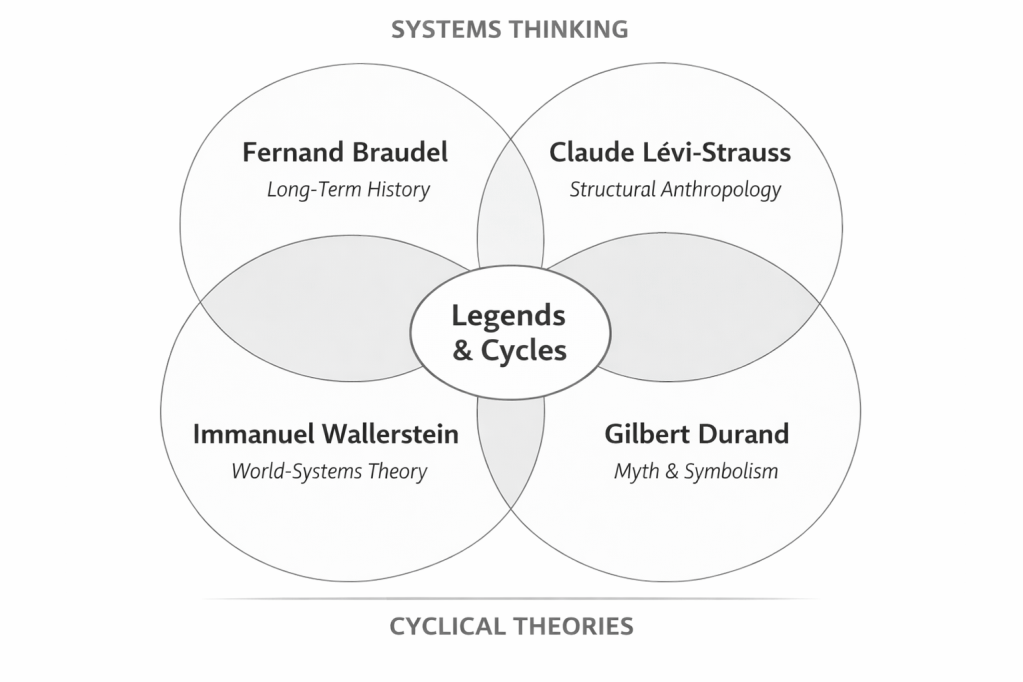
1. Structural Approaches
The first foundation lies in the identification of deep, often invisible structures that organize societies across time.
- Claude Lévi-Strauss revealed that myths and cultural systems are governed by underlying structures that remain stable beneath surface variations.
- Fernand Braudel introduced the concept of the longue durée, emphasizing slow-moving structures — geographical, economic, and social — that shape history beyond events.
Contribution to this project:
→ The focus on deep structures over events and the primacy of long-term constraints.
2. Cycles of Civilizations and Economies
The second foundation concerns the rhythmic evolution of systems over time.
- Arnold J. Toynbee explored the rise and decline of civilizations through recurring patterns.
- Oswald Spengler proposed morphological analogies between cultures.
- Nikolai Kondratiev identified long economic waves shaping industrial development.
Contribution to this project:
→ The concept that systems evolve through structured phases, not random change.
3. Systems and World Dynamics
A third dimension comes from systemic and global analysis.
- Immanuel Wallerstein analyzed the world as an interconnected economic system.
- Peter Turchin introduced quantitative modeling of long-term social dynamics.
Contribution to this project:
→ The understanding of regions and civilizations as interdependent systems.
4. Symbolic Structures and the Imaginary
The fourth foundation concerns the symbolic dimension of human societies.
- Carl Jung developed the concept of archetypes and collective unconscious.
- Mircea Eliade showed how myths structure perceptions of time and reality.
- Gilbert Durand formalized the structures of the imaginary and symbolic regimes.
Contribution to this project:
→ The idea that symbolic systems follow structured patterns comparable to economic or historical ones.ration, structure, and meaning — beyond noise and short-term narratives.
Position of Legends & Cycles
Legends & Cycles does not reproduce these frameworks separately.
It operates at their intersection.
Its core hypothesis is that cycles, structures, and symbolic systems are not independent — but form a unified architecture.
The project therefore proposes:
- a structural reading of markets and regions (Market Cycles),
- a spatial-symbolic reading of territories (zodiac frameworks),
- and a narrative reading of landscapes (legends and mythological patterns).
A converging approach
If structural anthropology explains forms,
and long-term history explains duration,
and systems theory explains interactions,
and symbolic analysis explains meaning,
then Legends & Cycles seeks to integrate these into a single framework:
a structural, cyclical, and symbolic reading of the world.
A distinct position
This approach remains:
- qualitative rather than purely quantitative,
- structural rather than event-driven,
- long-term rather than predictive,
- integrative rather than specialized.
In summary
Legends & Cycles can be understood as:
an attempt to map the deep structures of the world across time, space, and meaning.
 Jean-Marc Bélot: Legends and Cycles