Rules of Cyclical Displacement – Why centers move without disappearing
Cycles involve displacement, not erasure. One of the most consistent features of long-term history is the movement of functional centers industrial leadership, financial coordination, technological innovation, organizational capacity. When a cycle reaches maturity, its core functions tend to shift geographically, rather than vanish. Old centers rarely disappear entirely. They are repositioned. Displacement follows functions. Displacement does not occur randomly. It follows functions, not symbols or prestige. Functions that tend to move include manufacturing and production, logistics and energy corridors, system-level organization, and applied technological integration. Narrative dominance may remain in one place, while operational functions relocate elsewhere. Why displacement occurs. Several structural forces drive displacement: rising costs in mature centers, demographic constraints, institutional rigidity, and saturation of existing systems. Emerging regions often combine lower friction, adaptive institutions, and the capacity to integrate existing knowledge into new forms. Continuity beneath change. Although centers move, structures persist. New regions often replay similar functional roles, under different cultural expressions, with new technological layers. This continuity allows systems to endure — even as their geographic anchors shift. Displacement is gradual. Cyclical displacement is rarely sudden. It unfolds over decades, sometimes generations. During transition periods: multiple centers coexist, functions are distributed, and tensions increase. Understanding these phases is essential for avoiding simplistic narratives of “rise” and “decline.”
* History does not abandon its structures. It relocates them. *
Rule of Cyclical Displacement of Civilizational Centers – A structural formalization
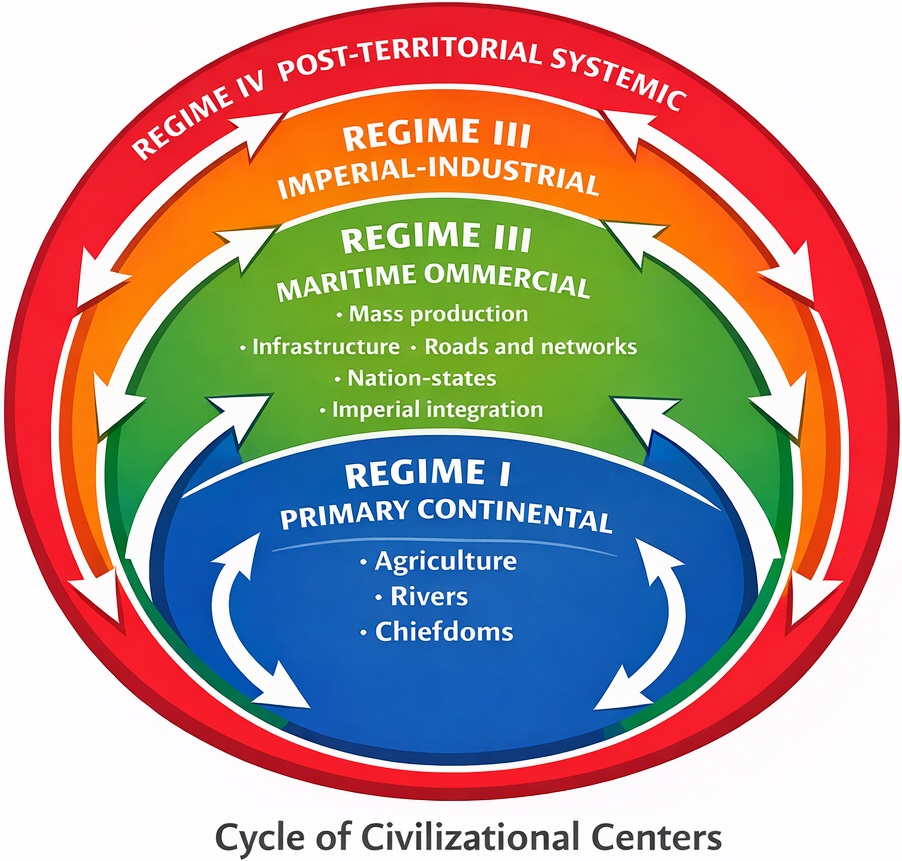
🔄 Rule of Migrating Centers. A civilizational center does not remain anchored to the same geographical location when it undergoes a major shift in technological, energetic, or organizational regime. At each threshold, the center tends to move toward the region that best combines energy availability, network position, demographic depth, and openness to systemic integration. This displacement is not accidental. It follows a recurrent structural logic observable across long historical durations.
🧩 The four successive regimes: I. Primary continental regime. This regime is grounded in agriculture, river systems, and early territorial states. Writing is limited or embryonic, exchanges remain regional, and political power is tied to land control. Key features: Energy: biomass and human labor; Organization: agrarian kingdoms, proto-states; Horizon: local or regional. Examples: Ancient Egypt, Mesopotamia, early China, ancient West Africa. ➡️ Role in the cycle: demographic and agricultural matrix. ➡️ Structural limit: rapid territorial saturation. II. Maritime commercial regime. This regime emerges when circulation overtakes production as the dominant organizing principle. Ports, navigation, monetary systems, and long-distance trade networks structure a connected world. Key features: Energy: wind, navigation, monsoon systems; Organization: merchant cities, port-based kingdoms; Exchanges: long-distance networks. Examples: Phoenicia, ancient India, Aksum, Carthage, East African and Swahili worlds. ➡️ Role in the cycle: accelerator and connector ➡️ Structural limit: dependence on routes and strategic vulnerability. III. Imperial industrial regime. When production, infrastructure, and norms become integrated at scale, imperial or industrial nation-states emerge. This regime stabilizes expansion but progressively accumulates rigidity. Key features: Energy: hydraulic, fossil, mechanical; Organization: empires, nation-states; Exchanges: global, hierarchical. Examples: Rome, imperial China, industrial Europe, the United States (Italy-function in the current cycle), Numidia / Hispania ↔ China (functional correspondence) ➡️ Role in the cycle: stabilization and scaling. ➡️ Structural limit: over-extension and systemic rigidity. IV. Systemic post-territorial regime. In this regime, power is no longer strictly grounded in territory. Finance, information, technology, and space redefine dominance. Control shifts from land to systems. Key features: Territoriality: relative and mobile; Energy: electrical, digital, nuclear, spatial; Organization: techno-financial blocs, networks. Emerging examples: Korea, Japan, Northern China, late-stage United States, Earth orbit and cislunar space as a new “America” ➡️ Role in the cycle: transcendence of the ground ➡️ Structural limit: loss of anchorage and systemic risk.
🧭 The displacement rule. At each regime transition, the civilizational center tends to move toward a former periphery that: was previously connected to the core system, possesses a latent surplus (demographic, technical, or geographic), and shows greater compatibility with the new dominant energy or technology. This logic explains recurrent displacements such as: America → orbital and cislunar space, Rome → Northern Europe, Europe → America, internal shifts within China (South ↔ North), India → East Africa → Southeast Asia.
🔮 Prospective implication. When read through this framework, current configurations suggest the emergence of a Northern China–Korea axis as a future hard center, while the United States increasingly plays a role analogous to late-cycle Italy: structurally central, but no longer the primary locus of regime innovation. In this context, the notion of a “new America” no longer refers to a continent, but to a systemic frontier — orbital, technological, and informational. General principle. A civilization does not progress where it was born. When a regime saturates, its center relocates — not randomly, but according to structural compatibility with the next dominant system.
🗺️ Functional correspondence map (structural analogy) Ancient world / Contemporary world / Systemic function : In a Forthcoming issue
* The history of civilizations is not a march forward. It is a sequence of relocations. *

 Jean-Marc Bélot: Legends and Cycles